

View from the Chair: Is the Tide Turning Toward Home Dialysis?

A couple of weeks ago, a member of one of the large dialysis-focused Facebook groups (not our Home Dialysis Central group) asked this question [sic]: “Y can’t they just take no for an answer why do they keep pushing home hemo is it for the money?” One of the longest social media threads I’ve encountered in the nephrology community ensued—34 pages and 365 responses from 326 participants, of which 325 from patients, care partners, and occasional nurses were germane to the question, so I color-coded and analyzed them. The answers were not what I expected: in a good way!
Most Respondents Believe Home is Best
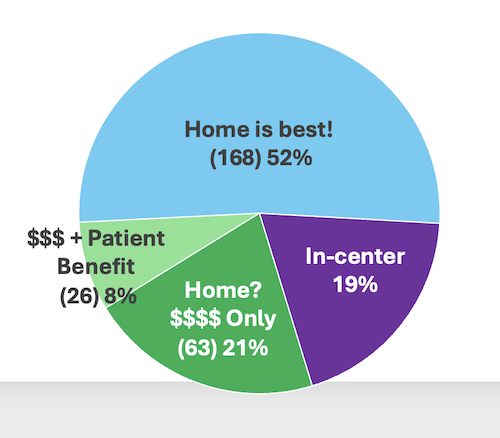
As you can see from the pie chart, 52% of patients’ statements—by far the largest segment—believe that home dialysis (PD and home HD) is not merely hype; there are real benefits for them, not just their clinics. Why? For reasons like these:
“Its about enabling you as a patient in self-care and the freedom to initiate your own treatments...with a worldwide shortage of dialysis techs and nurses.”
“I've heard home hemo much easier then in clinic hemo. I did in clinic hemo for 3 months i felt like it was killing me. I felt like sh*t all the time.”
“It’s way easier on your heart. I love home hemo. Best decision I made.”
“Home hemo is better for the body. I did it because I didn’t want to get up early every day and go out to sit with other sick people.”
“I do home hemo dialysis and it's the best thing that has happened to me. I work full-time and am in school full-time for my Master's all while doing dialysis from home 4 times a week at my leisure.”
“I had a sick 77 year old man come to me who barely had the energy to walk in his own home. I trained his wife to do Home hemo. Two months after going home he got a part-time job because he had so much energy and felt so good. The same man received a transplant last year.”
“He has so much control it’s amazing. He sets the amount of fluid removal and can change it during treatment, how fast or slow treatment goes (within set parameters of course) switch days or do morning vs evening to fits his day and most importantly how he feels.”
“I hate needles and didn’t think I could do it, but they can prescribe a numbing cream that you put on 30 min prior and you don’t feel anything. I used it also for the short time I was in center also. I refused to do it without.”
“I found it so much better x I could work full time and spend time with my family even when dialysing. My daughter would play and paint my toenails and we’d read books and watch films together…it made it not a horrific and dull life sucking experience and I would do 20 plus hrs a week so felt better too.”
“Peritoneal Dialysis I think is the best way to go. It’s done at home but it’s done every day and for me it was 3 times a day. Much more freedom and no blood involved and you don’t have to stick yourself.”
“I did manuals, because the machine caused me pain when it would draw out fluid. I couldn’t see me being in pain every night and trying to sleep.”
“In California they don’t offer paid compensation for the spouse!!! I am the full time caregiver for my wife and can’t get paid and it’s hard for me to find a job… so the financial struggle on top of what my wife goes thru on the daily is difficult!!!”
“Home hemo is so much better for your body. Slower pull rate is much easier on your body, less cramping, you can set how much fluid you want to pull, you can set the temp a bit warmer, you can do it on your time line, it is nice and quiet if you want, it is warmer, you don’t watch others dying around you.”

A Nuanced View: Clinic Dollars and Patient Benefits

The second largest group (26%) could see that both clinics and patients benefit from home therapies.
“Home hemo is widely seen as a better treatment for the patient at home, whilst it frees up another bed for someone else to do dialysis in the clinic.”
“It is hands down money. But the patient does typically feel better doing home.”
“I do home hemo and love it but they do push it a lot with the main point being it’s “gentler” on the body and more tolerable. Idk how true that is compared to the money they make off of sending you home with a machine tho.”
“There are bonuses for each patient who switches to home modalities but home hemo and peritoneal dialysis is better for your body and heart…”
“They are pushing it because there is an executive order targeting 80% of all esrd patients be on home dialysis or get a transplant. Yes, there are financial incentives to make this happen. That being said, it IS better for you only because you have the ability to do MORE frequent dialysis. Medicare spends the most of it's budget on dialysis, so they want better outcomes for dialysis patients, to off set costs of hospitalizations. This is only achieved by transplant or home dialysis. Patients on in center dialysis are not as healthy and have a much higher mortality rate. There is a lot that goes into the push for home.”
“Safer for your heart and it opens chairs for new patients to get started!!! I'll choose home every time!”
“It's actually better for you. I can't believe how much it's different. But I do believe they're making money by giving you four treatments a week instead of three.”
“Home is better because u dont have time for fluid and toxin build up between treatments and its less harsh on ur heart bc u r pulling way less due to less build up. Better for u...but yes they probably do make more money.”
“It’s actually better for you and it’s less money than in center. Also you run at a lower speed which is better for your heart.”
“PD makes them WAY more money than home hemo. They push home hemo because the survival rate for dialysis patients almost doubles vs. in-center. So I guess all the posts about it being for profit are correct.... the longer you live, the more money they make.”
With regard to the money aspect, it is definitely profitable for them because they don't need to have a tech on hand plus we use our own water and electricity. With that said, it also allows for space in clinic for those who aren't able to do HHD or for those who don't want to do it at home.”
Dialysis for Dollars?

The third group (21%) was skeptical, believing that clinics somehow benefit enough financially from home treatments that they are willing to push them—hard—to a group that really isn’t interested, let alone persuaded. Some even believed that clinics were aiming to force more people home so they could fill more in-center chairs.
“It's all about the $.”
“$$$$$$$$$$$$$$$$$$$$$$$$”
“Sure its all about the money. Everywhere. Sigh.”
“Ultimately it is all a for profit situation. They push so hard because if they can get you to do it then it opens up the chair in the clinic for another patient.”
“I think it's like self check out at the store. They still make the same profit, and don't have to pay for staff and a building.”
“Money and they want to fill chairs.”
“No matter what anyone tells you the reason is it's always an alterior motive $$!!! And I stand on tht!! Dialysis treats everyone in a cookie cutter manner rather thn as an individual. Each center & department (home hemo) has to maintain a certain quota to continue to operate so plz always advocate for yourself.”
“My Dr kept pushing it so I did some research and he was a shareholder in the company that supplied the equipment.”
“It has to be money because I had to curse out my home pd team for them to stop asking me to switch over. They hound you like it’s a miracle treatment.”
“They pushing it so they don’t have to hire. I told them No and don’t ask again and all this Better Mess, I don’t want to hear it. What’s good for some is f for others. The doctors also get something for Home and PD that’s why they still promote.”
“IT HAS TO BE FOR MONEY. I STARTED WITH MY CENTER IN NOVEMBER AND EVERYDAY I'VE BEEN THERE IT'S BEEN HOME DIALYSIS HOME DIALYSIS HOME DIALYSIS.”
“Yes its cheaper for them if you do it at home.”
“Heard the machine is 500,000 dollars and we had to return it after my husband had a transplant.”
“It's so they don't have to spend money on for you to have a tech to work your machine for you. I loved home hemo but my husband e was too stressed out by it.”
“I will say this, if you have a commercial insurance; then yes it could be for the insurance!”
Never-Home
Finally, the smallest group (19%) refused to even consider home therapies, in some cases due to myths:
“No room. Plus I live on my own, so if something goes wrong im screwed.”
“We prefer (in-center) hemo. I got burnt out severely being my husbands PD caregiver. The trash and everything that came along with it. It was so bad. We’re much happier with hemo.”
“Not everyone wants to needle themselves or do this at home.”
“Dialysis over time kills you slowly. Patients develop heart conditions because of the process. They push the younger stronger patients to home so yes they live longer. Why? Because they are just that, younger. A lot of center patients are older people. Dialysis sucks the life right out of you weather your at home or in center.”
“When your doing it yourself they had me on machine for 3 hours five days a Week sometimes 6. I was wiped out every day. I hated it and I did it twice in 11 years on dialysis.”
“I can't see sticking myself.”
“Not everyone is ready nor want that responsibility.”
“PD almost killed my wife, pushed fluid into her lungs.”
“They tried to push it on my wife a few ago. It's not as easy as you think plus we didn't really have the room in our home for it.”
“I didn't want dialysis to be at home my home is my home I wanted to feel happy and easy at home not stuck on the damn machine all day plus u do more hours at home and I like the fact at center I have a nurse by my side.”
Dialysis at home regardless if it’s Hemo or PD is not for everybody. I personally was not interested in doing Dialysis at home when I first started. I was 25 and had just gotten out of the hospital after 23 days 17 in ICU on a ventilator... The unit was inside of a hospital. I felt more comfortable there just in case something bad happened to me. I would already be at the hospital. My second time on dialysis which was in 2023, I considered home Hemo and was told that it was going to be a couple of weeks of training and I knew that I wasn’t gonna be on the machine that long before transplantation, so I winded up going to a clinic downstairs from my job. We all should be making the decisions that we feel are correct for our bodies and our health. And if you’ve already said no, there’s no reason to have to continually say it.”
“Butttttttttttt they don’t really tell you about all of the cons. TRUST ME ITS NOT WORTH THE RISK.”

Conclusion
It was clear from this conversation that some patients did feel pressured by frequent mentions of home dialysis. I strongly suspect that these approaches were what I call, “Modality first.” These conversations tend to start out with phrases like, “You would do so great on PD!” or, “Have you thought about home hemo?!”
Unfortunately, while typical, modality-first approaches forget that patients aren’t enthusiastic about any type of kidney replacement therapy, so we are in the position of selling ice to Arctic dwellers who do not want or need it.
Instead, consider asking “What matters to you?” and helping patients match the options with what they want their lives to look like. When people understand what’s in it for them—not just their clinics—to take on the responsibilities of home treatments, they can surprise you. My Kidney Life Plan is a free, online, evidence-based decision aid in English and Spanish that includes every treatment option and can make that conversation easier and more productive.
Comments