

The Tandem of Care: Lessons in Partnership

As a nephrologist specializing in home dialysis, I spend my days witnessing a specific kind of quiet heroism. I see patients and care partners who transform their spare bedrooms into clinics and their relationships into lifelines. It is a world that requires immense dedication, but more than that, it requires a level of synchronicity that most people never have to develop.
I recently found the perfect analogy for this bond through one of my dear patients and her devoted spouse who navigated this journey with incredible grace. When they shared with me that they ride tandem bikes—clocking over 1,200 miles together—I was floored. Personally, I told them I couldn’t imagine doing that without ending up on the pavement, likely shouting at my partner in a comedic heap of limbs. Yet they don’t just survive the ride; they thrive on it.
The Captain and the Stoker
In tandem cycling, the roles are distinct. The "Captain" at the front handles the steering, the brakes, and the balance. The "Stoker" in the back provides the power and, most importantly, the trust.
In the world of home hemodialysis, I see them mirror these roles every day:
The Power of Trust: Just as the stoker must trust the captain to navigate a sudden curve, the patient must trust their partner’s precision with the machine.
The Burden of Balance: The care partner, like the captain, carries the weight of "steering" the treatment—managing alarms, needles, and logistics. It is a heavy lift; research shows that approximately 88% of dialysis caregivers experience moderate to severe fatigue [1], and many see their physical health-related quality of life decline significantly within the first year [2]. Spousal caregivers face a significantly higher burden, often acting as "hidden patients" whose own physical and mental health can be compromised by the demands of care [3].
Shared Vision: When they are in sync, the stoker can actually let go of the handlebars to take a photo. This is the heart of what I want for them: to create enough safety so that the patient can enjoy the scenery of their lives again.
Practicing the Pedal Stroke: Building Autonomy

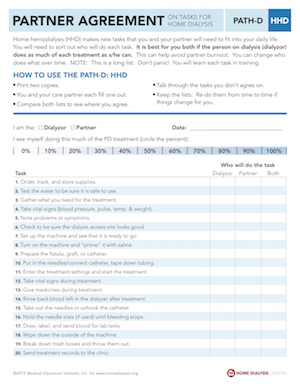
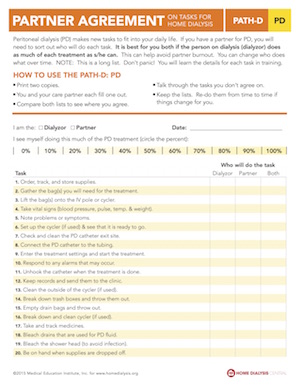
Becoming a better stoker isn’t passive; it requires practice and intention. In the same way, a patient’s role in home dialysis can evolve from being a passenger to a co-pilot. To help navigate this, we use tools like the Partner Agreement on Tasks for Home Dialysis (PATH-D) [4].
Think of PATH-D as the pre-ride checklist for a tandem team. It allows the dyad to:
Define Roles Clearly: By assigning specific tasks, it prevents "pedal steer” where two people pull in opposite directions [3].
Encourage Growth: Just as a cyclist builds stamina, PATH-D helps patients identify skills they can take over. This intentional shift increases patient autonomy and prevents the care partner from carrying the entire "weight of the bike" [4].
Promote Mutual Agency: By clearly identifying who does what, the care partner can reclaim some of their own "lane," ensuring that the patient's growth supports the partner's own well-being.
Avoiding the Solo Climb: Peer Support and Respite
Even the strongest teams shouldn't have to pedal alone. Staying "on the road" requires more than just clinical skills; it requires a community of other riders and scheduled rest stops.
The Value of the Peloton: Peer support programs act as a cycling club for home dialysis. These connections help relieve the isolation and distress that often come with caregiving [11].
Scheduled Pit Stops: Respite care is essential for long-term endurance. Anticipating care partner burden allows us to deploy support programs and provide necessary breaks before a team reaches the point of exhaustion [11].
The High Stakes of Exhaustion: Modality Failure
The beauty of the tandem bike is that it’s faster and more efficient than a solo rider—if you are in sync. But when the rhythm breaks, the consequences are significant:
The Breaking Point: Caregiver burnout is one of the most common reasons for modality failure—when a patient must stop home therapy and return to an in-center clinic [12]. Recent studies indicate that features of burnout are present in over 50% of dialysis caregivers [13].
Impact on Technique: When a caregiver reaches the point of exhaustion, the risk of "skipping gears" increases. Fatigue can lead to unintentional lapses in dialysis technique, which directly increases the risk of complications like peritonitis or vascular access infections [13].
The "Hidden Patient" Crisis: Without intervention, increased distress can result in family isolation and disorders in family relations, eventually leading to the patient giving up the treatment entirely [3].
Staying in the Race
How do we keep our "captains" and "stokers" on the road? Science suggests that the most effective way to prevent burnout is through psychoeducational support and proactive tools [8]. Routine screening using the Zarit Burden Interview (ZBI) helps us identify high-risk teams early [9], while resources like PATH-D provide the structure needed to maintain a balanced partnership.
My goal as a physician is to move beyond just the medical roadmap. We need to offer stress management, empowerment-based approaches, and even telemedicine mentoring to ensure the spouse isn't pedaling alone [10].
The 1,200 Milestone
This couple was told it could take 20 hours of riding just to get in sync, but they found their rhythm almost immediately. To me, they represent the gold standard of what we strive for: a partnership so seamless that the "work" of the treatment fades into the background, leaving only the journey ahead.
As their doctor, I am truly humbled by their 1,239 miles. They remind me that while I provide the roadmap, they are the ones doing the pedaling—together, in perfect, trusting harmony.
In awe of your rhythm and strength,
Maria Camila Bermudez, MD
References
1. Akbari R, et al. BMC Psychiatry. 2023.
2. Driehuis E, et al. AJKD. 2026.
3. Driehuis E, et al. AJKD. 2025.
4. MEI. PATH-D Tool. Home Dialysis Central.
5. Araújo H, et al. J Adv Nurs. 2025.
6. Intas G, et al. Adv Exp Med Biol. 2020.
7. Bártolo A, et al. Disabil Rehabil. 2022.
8. Chan CT, et al. AJKD. 2020.
9. The Burden of Home Dialysis. PMC. 2024.
10. Caregiver Burnout and Risk of Peritonitis. IntechOpen. 2022.
Comments