

First, They Flew a Sausage
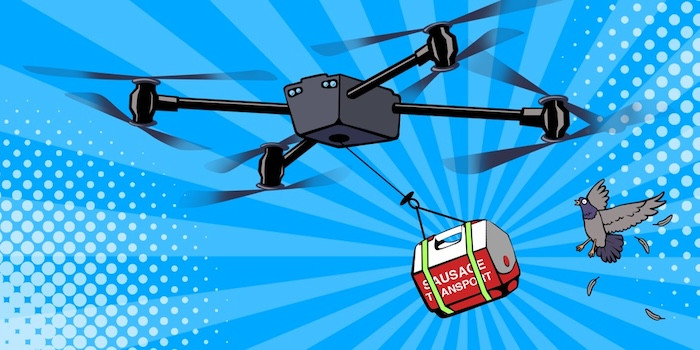
Cover art by Kellen Savannah Johnston
I feel like we have been hearing a lot about drones lately: a technology that makes me feel uneasy and hopeful at the same time. We have been seeing a lot of forward innovation with drones being used in Ukraine’s defense. We have also seen drones used in surveillance and in ways that frighten civilians. It is noteworthy—and horrifying—that militaries around the world are doing things with AI drones that literally have “Terminator mode,” and that is exactly what they do. (As if we were not warned about this by Arnold Schwarzenegger, but I digress). I think it’s fair to say that drones are tools that make distance and danger look different than ever before.
To be fair, they also make for stellar fireworks replacements, impossible and impressive photography, medical supply delivery tools, and the next best way Amazon can urgently get a package of phone chargers or cat treats to our doorstep in seven minutes or less. So, yeah. There are many ways to use drone technology.
Here’s a mind-blowing new one: NASA, UNOS, and LifeNet recently test-flew drones carrying human kidneys.
To be more exact, the drones picked up kidneys and flew them beyond the “line of sight” usually required for drone flights. The goal is to explore whether drones could transport organs for donation by about 15 miles with a pilot operating and overseeing the craft remotely. It was exciting to see a drone story that was not about precision annihilation, convenience, or entertainment, but about the lifesaving, time-sensitive, fragile delivery of organs that could (someday) be used for transplant. That is just so cool, isn’t it?
The Sausage
To be perfectly honest, the nephrology topic pulled me in, but what really caught my attention was the sausage.
You see, before flying the precious cargo of a human kidney, NASA Langley reportedly spent months testing the idea…with sausage.These are the kinds of details that make science feel human to me.

It sounds ridiculous at first, and yes, it’s amusing to think about. But really, it makes sense. You cannot start by strapping a viable organ onto a drone and attempting to shlep it off to a patient. You must start with something low risk. So, you test the box. You test the flight path. You test the timing, temperature, altitude, pressure and different atmospheric conditions. And, since it’s NASA, they probably tested a million other things the rest of us would not even think to be concerned about, including whether the entire plan is remotely reasonable in real-world conditions.
After so much testing, they flew a sausage. After the sausage, they flew a kidney. Then, another. And that’s both bizarre and amazing to me.
A Real Question
The recent drone tests were not a random science publicity stunt. LifeNet Health, NASA Langley Research Center, and the United Network for Organ Sharing (UNOS) partnered on a study looking at whether drones could help improve organ transportation.
In case you need a recap:
UNOS is a non-profit organization that manages parts of the US organ donation and transplant system, under contract with the federal government.
LifeNet Health is a global leader in regenerative medicine, organ and tissue donation, and research.
And NASA is clearly home to the kind of aviation engineers who are able to answer questions like, “Can we see what would happen if we flew a kidney by drone?”
Of course, the human kidneys ultimately used in the study were nonviable for transplant. They were research kidneys. I do not know the viability status of the sausage used in the test, or the variety. If anyone from NASA wants to disclose this, I promise I am genuinely curious. But back to the kidneys…
The kidneys were assessed and biopsied before and after the drone flights. Researchers monitored factors like temperature, pressure, altitude, and circulation. Preliminary findings showed no evidence that the flights themselves harmed the kidneys. And that’s where the story stops being quirky and starts being awesome. A sausage is funny. A kidney arriving unscathed after a monitored drone flight is the beginning of something profound. Imagine if drones could move organs faster, safer, and more reliably than humans transporting them on the ground, and through traffic?
Why It Matters
For most people, organ transplant is pretty invisible. A person on a transplant waitlist has to plan the logistics on their end. They may imagine receiving “the call” and being told a kidney is available. They may imagine grabbing the bag and rushing to the hospital, frantically calling family along the way. They may anticipate feeling terrified, rushed, hopeful, shocked, or any combination of those feelings.
What they may not imagine is the kidney’s journey. A kidney’s journey to the recipient is quite… different.

Often, the day starts off as any other for that kidney. Then, through some tragic circumstance, its original owner died. This is the part of transplant we can never forget. Every deceased organ transplant began with a loss.
After death, the kidney must be harvested. There may have been an honor walk. The kidney then must be recovered. Next, it must be tested, preserved, packaged safely, and transported to its new owner. This is a lot for a kidney, especially one that has already had a very long and very difficult day.
Sometimes a kidney needs to move from one hospital to another. Sometimes from one state to another. Sometimes it travels the way the rest of us do: by vehicle from a hospital to an airport, onto a commercial flight, then to another airport for a connection, into another transport vehicle, and finally to a transplant center. Under ideal conditions, a donated kidney can be preserved for up to 36 hours. Hearts and lungs have only 2-6 hours.
 Meanwhile, traffic can always
do what traffic does best—ruin plans and inconvenience everyone. There
are often multiple handoffs, coolers, people working to organize the
transplant, loading docks to navigate, parking lots to cross, parking
attendants to schmooze, multiple hospital entrances to figure out, mazes
of confusing hallways to navigate, endless rules to follow.
There are many opportunities for time to slip away,
and time is of the essence.
Meanwhile, traffic can always
do what traffic does best—ruin plans and inconvenience everyone. There
are often multiple handoffs, coolers, people working to organize the
transplant, loading docks to navigate, parking lots to cross, parking
attendants to schmooze, multiple hospital entrances to figure out, mazes
of confusing hallways to navigate, endless rules to follow.
There are many opportunities for time to slip away,
and time is of the essence.
A donated organ is a gift of life. It is not a phone charger or a cat treat. It’s not something that should ever be delayed in transit because someone hit construction, missed a turn, got stuck in gridlock traffic, rubbernecked, or could not find the correct hospital entrance.
There are also risks built in for organ transplant professionals. For those of you interested in crazy facts, the fatality risk in transplant aviation is significantly higher than in commercial aviation. Organ transportation failure can be catastrophic to multiple lives and families. Tragedies like this benefit literally no one.
The “Last Mile” Problem
The vision behind using drones for organ transport is not to ultimately fly kidneys from California to New York through thunderstorms, blizzards, tornadoes, and—I don’t know—geese, like some kind of transplant-themed side quest starring Capt. Sully. We will still rely on usual forms of transportation.
But for anyone who has
watched their ETA go from 12 minutes to 58 minutes because of traffic
and rubbernecking knows that distance and time rarely mean the
same thing. 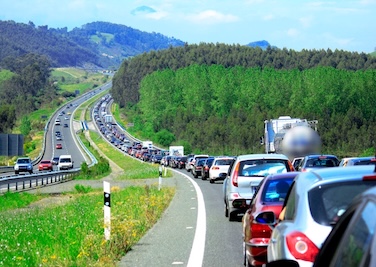 In cities and populated places where gridlock
traffic can take forever to navigate, a drone may be able to
fly a direct route. It can avoid the roads. It may be able to move an
organ from an airport to a hospital, or from one hospital to another
without being beholden to a fender bender, parade route, the world’s
slowest left turn, or an unfortunate
bridge. Drones aren’t magic, but having a new mode of transportation
is a significant development, especially for the last few miles.
In cities and populated places where gridlock
traffic can take forever to navigate, a drone may be able to
fly a direct route. It can avoid the roads. It may be able to move an
organ from an airport to a hospital, or from one hospital to another
without being beholden to a fender bender, parade route, the world’s
slowest left turn, or an unfortunate
bridge. Drones aren’t magic, but having a new mode of transportation
is a significant development, especially for the last few miles.
The “last mile” is often where transplant logistics get messy anyway. A kidney may have already traveled a long distance by plane, only to face traffic at the end of a journey. Other organs have even less time to spare. If a drone could reduce delay in that final stretch, it could make a meaningful difference.
More than 100,000 people in the United States are waiting for an organ transplant. Every possible improvement in the transplant chain matters, because donated organs are too precious to waste.
Worth Studying
Drones are not the secret fix to the many issues vexing transplant. They will not create more donor organs, and they won’t solve waitlist deaths. They will not fix inequities in referral, evaluation, insurance, access, geography, or transportation. They won’t make transplant less medically or emotionally complicated. They will do absolutely nothing to erase the grief that makes deceased donation possible in the first place.
They will also bring their own unique set of questions. Off the top of my head, I have:

What happens in bad weather?
What happens if a drone fails?
Who is responsible for the organ during transport?
How is chain of custody protected?
Who regulates the flight path?
What happens in congested airspace?
How is the organ monitored?
How can OPOs, transplant centers, aviation professionals, hospitals, doctors, and regulators coordinate this?
Where is the hidden government paperwork waiting to ruin the good vibes?
Still, if drones can help move a kidney across a congested city faster than a car, I’m supportive of the effort. If drones can help transport blood products, lab specimens, critical medications, and solid organs to where they are needed without delay or risk, I’m excited.
Conflict and Care
The part I keep coming back to is the crossover between technology used in conflict and the technology used in care. They’re so similar sometimes. Drones can be used to wield incredible destruction. We know that because we’ve seen it. But, modern conflict has forced people to think differently about how we build the positive parts of our futures too. What do we do when supplies need to be moved across impassable roads, through damaged infrastructure, when the need is immense and time is brutally limited? Similar logistics exist in disaster zones, battlefields, and medicine.
First, they flew a sausage.

Yes, I am still delighted by the sausage. It’s so weird! But, it also says a lot about how progress works. First, you do something ordinary. Then, you try something extraordinary. And, maybe someday, because of a sausage, more organs can arrive on time.
Comments