

For Better Days Ahead, Dialyze at Night

“Time waits for no one.”
The lyric from a song released by The Rolling Stones in 1974 might be a good motto for people with kidney disease who want to maintain control of their lives.
Time is precious for patients who want to minimize the role of dialysis as they continue to work or enjoy family.

Home dialysis offers that opportunity with individualized therapy and flexible treatment times, but what about dialyzing during the night?
“Patients are asking about overnight dialysis,” nephrologist Brigitte Schiller, MD, said in an interview. “They tell me, ‘We want to have the day to ourselves.’ Nocturnal home hemodialysis offers that to some patients.”
It’s an offer that Ben Ruback wanted to explore after focal segmental glomerulosclerosis (FSGS), diagnosed at age 5, brought an end to a living donor kidney transplant and use of other dialysis therapies, including in-center hemodialysis and peritoneal dialysis. By the time he entered high school, Ruback was looking for a new therapy – and success with home hemodialysis eventually led to experimenting with doing dialysis during the night.
“I was desperate for an alternative,” Ruback, 40. recalled during an interview. “Get me the heck out of the clinic…there had to be a better way.”
Schiller said nocturnal home hemodialysis (NHHD) is a great solution for a patient like Ruback, who is trying to balance raising two young children and still pursue professional education. “Patient groups believe it offers an improved quality of life - better appetite, less fatigue, and the opportunity to go about normal living. It’s a more logical treatment approach.”
Choosing Candidates
Existing HHD patients are the best candidates to try nocturnal hemodialysis. “In my practice, we advised patients to continue the more frequent HHD schedule, but dialyze at least every other night to four times per week when switching to nocturnal, resulting in 20–32 hours of treatment per week,” Schiller said. Treating physicians may consider prescribing a blood flow rate of 250–300 ml/min based on the patient’s needs. Decreased flow rates may help minimize the frequency of arterial and venous pressure alarms.
The nighttime therapy has a lot of potential: in 2023, only 2.4% of patients were on home hemodialysis, and a small fraction of those patients were dialyzing overnight, according to the U.S. Renal Data System’s 2025 Annual Data Report.
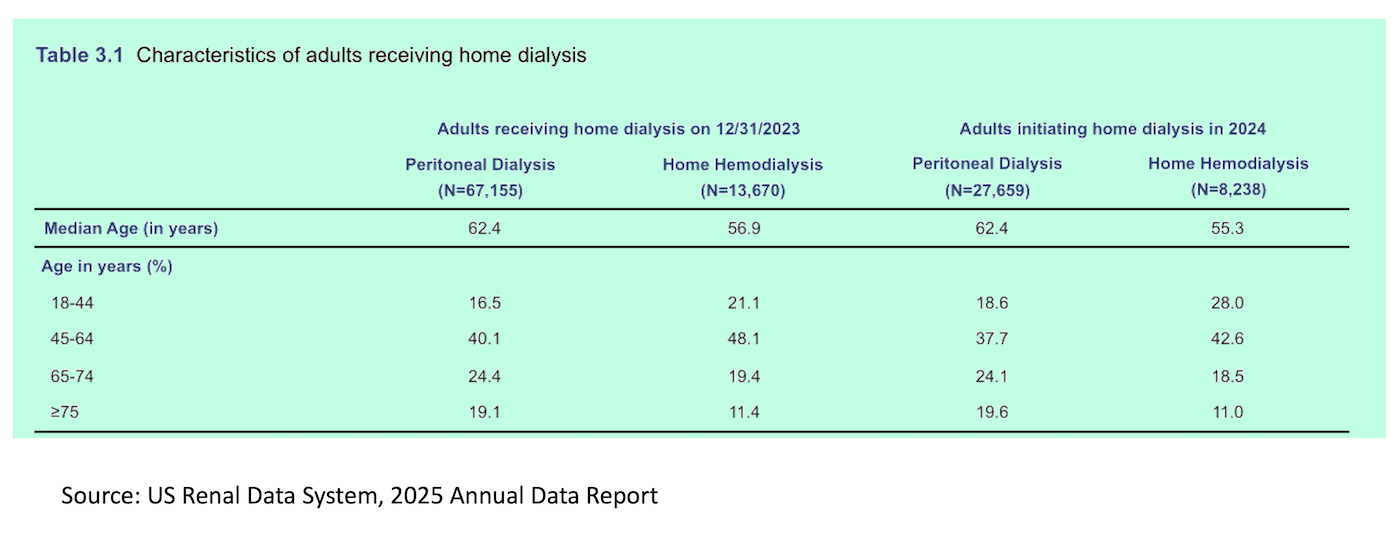
There are about 350,000 prevalent patients with end-stage kidney disease between 25-59 years old. Ruback is in that age group, and started home therapy “when I was desperate to enjoy my life as much as possible, and felt that the time required to do in center treatments, from the travel there and back, the treatment itself, and, importantly, feeling wiped out and unable to function for the remainder of the day - was simply taking too much from my life, when I had so much I wanted to do and try.
“I was drawn toward HHD by the promise of feeling significantly better before, during and after treatments, with the more frequent treatments and limited fluid and electrolyte shifts,” Ruback said.
Clinical Benefits
Long, slow dialysis, as Ruback describes, can have particular benefits for the cardiovascular system. “It can help reduce the risk of cardiac stunning that conventional thrice weekly dialysis can bring,” Schiller said. The therapy can include both nighttime and daytime dialysis to accommodate patient needs and comfort levels.

“Patients may wish to do nocturnal treatments 1–2 times per week and shorter treatments on other days to allow dialysis to fit around their specific life schedules,” Schiller and colleagues wrote in the paper, “How I treat nocturnal home hemodialysis - an under-prescribed but essential home dialysis modality in the United States.” 1
In the paper, the authors theorized that reluctance by nephrologists to prescribe nocturnal therapy to an existing HHD patient “is often due to lack of comfort with [patients] dialyzing while sleeping rather than a specific contraindication or logistical constraint.”
Schiller believes patient advisory boards can work in tandem with physicians to direct change and help explain that spending more time on dialysis, whether HHD or NHHD, has benefits. “We had a study group of HHD patients who told us, ‘Nocturnal doesn’t work for me.’ But we found that modality education and persistence paid off: 3 of 12 patients in the group decided to start nocturnal dialysis,” she said.
For most patients, “the biggest concern is about needle dislodgement,” Schiller said. “But there are measures that can be taken such as sensors at the cannulation sites that help detect blood leaks.”
Ruback said it took some time to convince his own nephrologists that nocturnal HHD could be beneficial. “When I transitioned to home dialysis in 2007, I remember that my renal doctors had clear reservations. They were concerned I’d be doing unmonitored treatments, without someone like a nurse or tech to assist, should the ‘what if’ occur in the home setting.”
“Nephrologists are even now not nearly as familiar with these types of therapies compared to in-center dialysis,” Ruback said, “and it feels to me that this leads to a relative absence of choice when a person begins dialysis. They aren’t always informed of the options, especially regarding HHD.”
Centers of Excellence
How best to spread the word about the benefits of overnight dialysis—and help patients feel more comfortable with the technical aspects of nocturnal HHD? Schiller believes providers can establish centers of excellence that focus on this therapy. “We can teach physicians about the techniques and make people feel confident with change,” she said.

Ruback added, “I also believe that many more patients would be open to HHD if they didn’t need to learn to cannulate themselves. That has been a big obstacle for some of the patients I’ve talked to who are interested, but reluctant to take the leap.”
Teaching or assisting patients needing to learn the art of cannulation so then can stay home is a focus of new legislation introduced by U.S. Rep. Carol Miller (R-WV) that would offer Medicare coverage of staff assistants for patients who chose home dialysis. Her bill, Improving Home Dialysis Act, passed the House Ways and Means Committee by a 28-13 vote on May 26. The bill, H.R. 8875, would reinforce the requirement that all Medicare-approved dialysis providers must offer modality options education to all patients. The bill would also require them to offer renal mental health support services to help patients with the transition to home dialysis and promote kidney transplantation and would expand the network of healthcare providers who can offer home dialysis training (including telehealth and group training) to cut down waiting times, Miller’s office said.
That transition process would be aided by a measure in the bill that for the first time would allow Medicare to pay directly for trained home dialysis aides – covering individuals who could help patients set up their home dialysis machines for either short daily treatment or less-frequent nocturnal dialysis.
“If you are a home dialysis patient, you should have the same access to quality support services as someone receiving dialysis in-center,” Miller said in a statement about her bill. “Patients should not be penalized for choosing a modality that often provides greater flexibility, independence, and quality of life.”
The legislation is supported by the National Kidney Foundation and the American Society of Nephrology.
The Potential of Nocturnal HHD
While various efforts have been made by the Center for Medicare and Medicaid Services (CMS) to encourage more home dialysis, there have been some bright spots in the ongoing Kidney Care Choices demonstration. The CMS payment model, launched in 2022, brings primary care physicians and nephrologists together to manage the care of patients in CKD stages 4-5 and on dialysis. The intent is to reduce fragmented care and high-cost treatments often seen among fee-for-service payment models that do little to slow disease progression.
Part of that effort focuses on patient education on modality options, including home dialysis. Some recent data from the demonstration shows that, among fee-for-service beneficiaries with stage 4 or 5 CKD who started dialysis in 2022 and 2023, a higher percentage of those who were aligned with practices participating in the Comprehensive Kidney Care Contracting model started home dialysis as their initial modality compared with those not treated in CKCC practices.

“In the first quarter of 2022, the difference was 5.9%, but by the fourth quarter, the difference had increased to 10.2%,” according to a CMS report.
Schiller said she is optimistic about results coming from the kidney care models; studies have shown that more patients choose home therapies when they are included in modality options education.
“The data are very positive that more patients over 65 years old are asking about PD and HHD than ever before,” Schiller said. “We have to make sure that patients and their partners who chose this option get respite care. The bigger you get as a program, the more effort is needed at patient retention. An 82-year-old patient managing dialysis at home often needs more attention than younger patients without comorbid conditions. And HHD candidates indicate that more attention/support to managing the therapy is of value.”
Ruback knows about the rigors of nocturnal home therapy but believes it is the right one for him. “I felt overjoyed about feeling well and having my days – and going to class” when he started on HHD, Ruback said. “It was a total win.”
Now on nocturnal dialysis, he can help take care of his young children, Archie and Nellie, while his wife Andrea works and he pursues a master’s in education. “I have been on dialysis almost 3 decades now. I’m exhausted a lot of the time, but I know I would have had a very limited life if I had to be in-center for my dialysis.”
References
Liu, Frank et al. How I treat nocturnal home hemodialysis—An under prescribed but essential home dialysis modality in the United States. Clin Jrnl Am Soc of Neph. October 10, 2025. DOI:10.2215/CJN.0000000927.
Comments